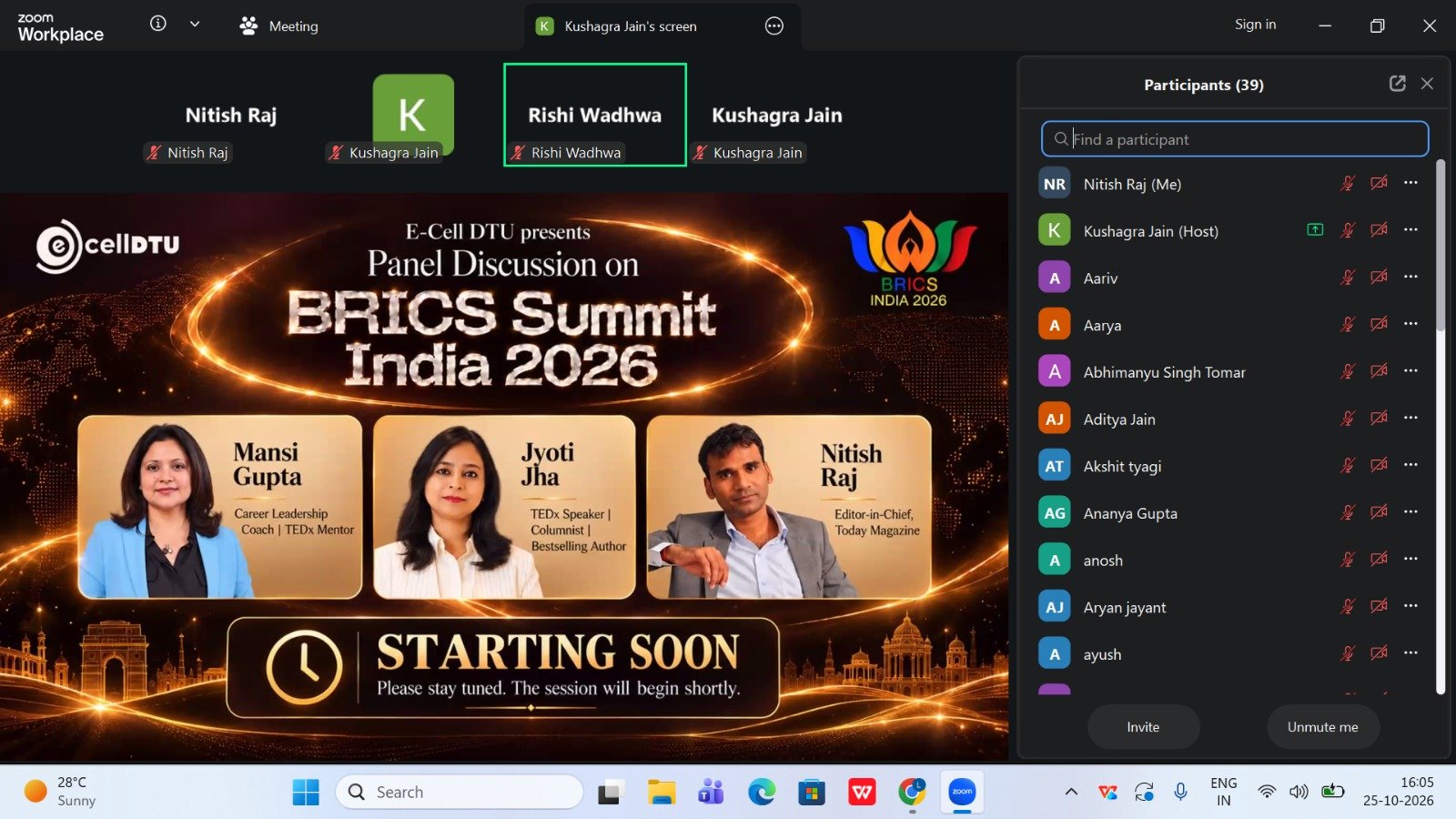
At an online panel discussion hosted by the Entrepreneurship Cell of Delhi Technological University, speakers explored India’s growing global role, the opportunities offered by BRICS, and the importance of translating international dialogue into meaningful outcomes for young people, entrepreneurs and communities.
Beyond Diplomacy: A People-Centric Vision of Global Cooperation
The BRICS Summit India 2026 provided the backdrop for a thought-provoking online panel discussion organized by the Entrepreneurship Cell of Delhi Technological University (DTU). Bringing together voices from literature, corporate training, entrepreneurship and media, the discussion examined how India could use international cooperation to advance economic growth, technological innovation, inclusive development and opportunities for the next generation.
Moderated by student hosts Parth, Tanuj and Navya Abrol, the discussion featured author and literary curator Jyoti Jha, corporate trainer and author Mansi Gupta, and Nitish Raj, literary critic, entrepreneur, founder of Today Magazine and Editor-in-Chief of The Literary Mirror. The panel moved beyond conventional conversations about geopolitics to explore a fundamental question: how can international partnerships translate into tangible benefits for ordinary citizens?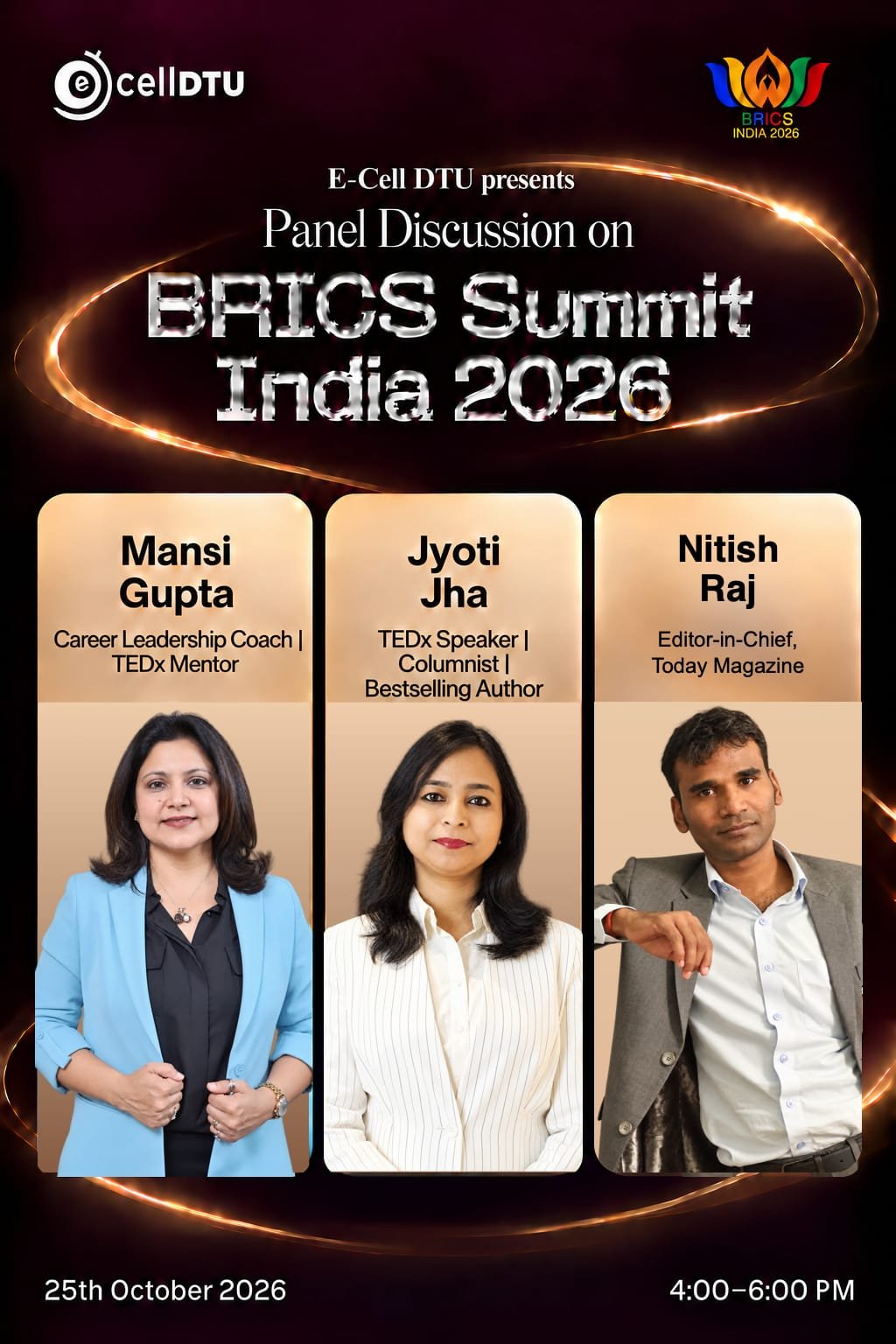
A recurring theme throughout the discussion was that global leadership must ultimately be measured by its impact on people. Economic growth, diplomatic influence and international recognition matter, but their real value lies in creating opportunities, improving lives and enabling communities to participate in development.
Mansi Gupta emphasized that global cooperation should not remain confined to political leaders and summit meetings. Its purpose, she argued, must be to create meaningful opportunities for people on the ground. She highlighted sustainability, resilience, mental well-being, innovation and cooperation as shared challenges that require countries to work together.
She also offered a compelling perspective on India's role in international affairs: leadership should not simply be about securing a seat at the table; it should be about making the table bigger. This idea of expanding participation captured the spirit of the conversation, placing inclusion at the centre of India's engagement with the world.
India's Civilizational Wisdom and Global Identity
Responding to questions about India's distinctive strengths within BRICS, Jyoti Jha highlighted the country's rich cultural heritage, democratic values, economic dynamism and long civilizational history.
India, she suggested, possesses an important combination of traditional wisdom and contemporary ambition. Its cultural inheritance offers perspectives on collective responsibility and coexistence, while its development journey demonstrates the possibilities of economic progress within a diverse society.
Ms. Jha also underlined the significance of inclusion. India's contribution to international cooperation should extend beyond representing itself on the global stage; it should help ensure that more countries and communities have a meaningful voice in shaping shared priorities.
The discussion also explored India's potential to act as a bridge between developed economies and the aspirations of the Global South. Ms. Gupta noted that countries across the Global South differ in their priorities, capacities and development challenges. Nevertheless, they share aspirations for fair representation and greater access to opportunities.
India's position, she argued, allows it to encourage constructive engagement between countries with different perspectives. Effective diplomacy requires the confidence to discuss difficult issues while maintaining a willingness to listen, negotiate and identify common ground.
The panel thus presented global leadership not as a contest for dominance but as an opportunity to facilitate dialogue, build trust and advance shared objectives.
Vasudhaiva Kutumbakam: The World as One Family
Nitish Raj connected the expanding BRICS framework with the Indian philosophy of Vasudhaiva Kutumbakam—the world is one family—and the cultural principle of Atithi Devo Bhava, which accords special importance to guests.
Drawing on the idea of a family, he explained that countries do not necessarily possess equal resources, expertise or capabilities. Some may have stronger technological systems, while others may offer different forms of knowledge or experience. Cooperation becomes meaningful when countries learn from one another and contribute their respective strengths.
He emphasised that international partnerships should not be understood as one country teaching another. Instead, they should create opportunities for reciprocal learning.
This approach is particularly relevant to an increasingly interconnected world, where countries face challenges that cannot always be addressed independently. By sharing expertise, exchanging ideas and reducing barriers to cooperation, nations can work towards outcomes that benefit a wider population.
The discussion presented India's civilizational philosophy as a useful framework for thinking about international relations: partnership is strongest when it is built on mutual respect rather than assumptions of superiority.
Jobs, Entrepreneurship and the Power of Technology
The second major strand of the discussion focused on employment, business, technology and entrepreneurship. The speakers explored how BRICS partnerships could help Indian entrepreneurs access international markets, attract investment and learn from business ecosystems in other countries.
Ms. Gupta argued that collaboration between nations can create opportunities for founders, professionals and technology-driven businesses. International forums allow participants to exchange ideas, discuss common challenges and discover approaches that may be adapted to their own markets.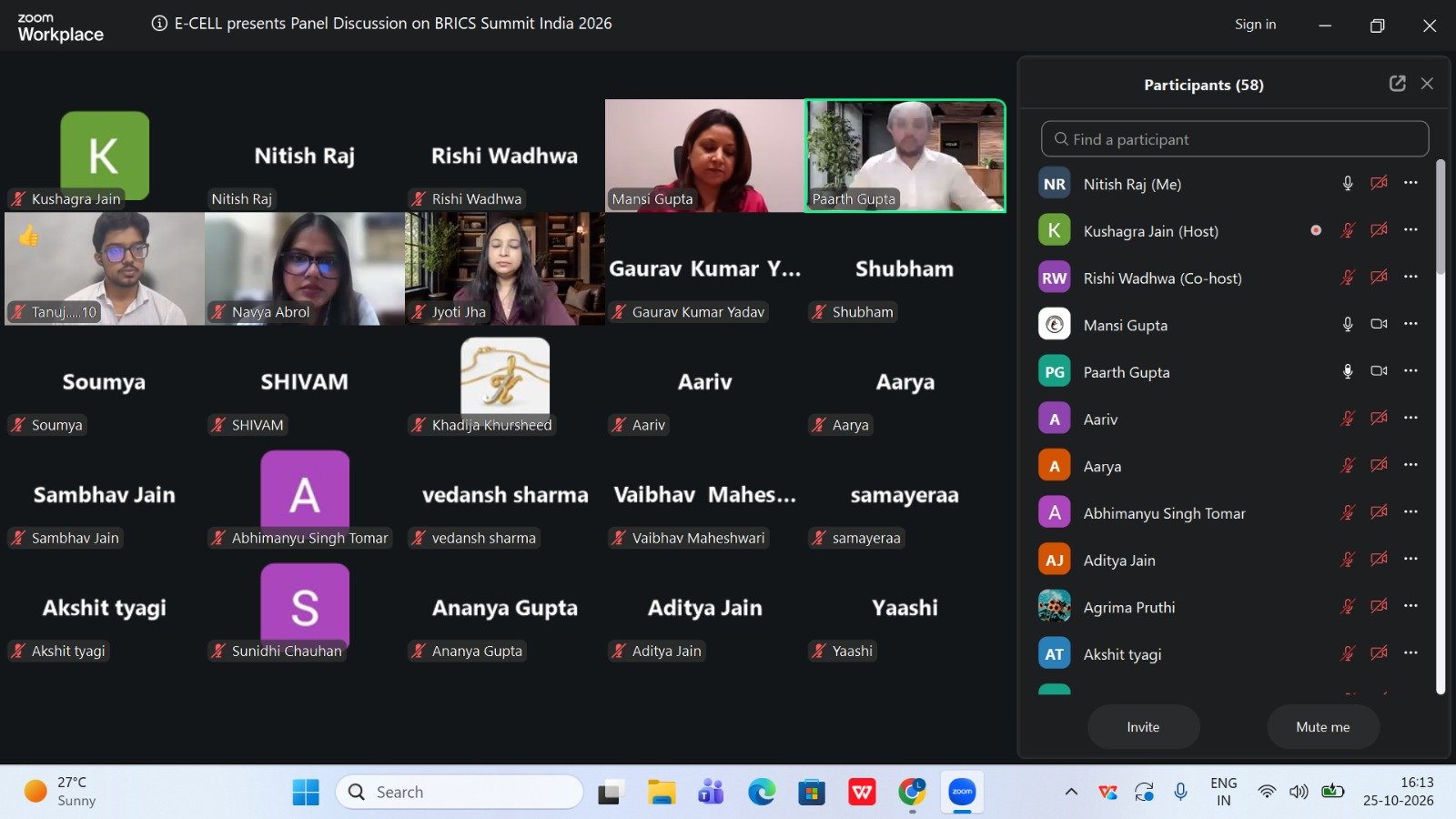
Her observations drew on interactions with entrepreneurs and professionals from different countries. Such encounters, she suggested, can generate practical learning that extends beyond formal agreements and diplomatic statements.
Mr. Raj developed this argument by focusing on the exchange of technological knowledge and institutional practices. He raised questions about what makes India's engineering talent competitive and what other countries might teach India about facilitating business, supporting innovation and improving the conditions in which entrepreneurs operate.
He also encouraged young people to approach international platforms as learning environments. Students and aspiring professionals can benefit from meeting people with different experiences, identifying successful practices and reflecting on how these might be applied in their own contexts.
The underlying message was clear: technological leadership requires both confidence in domestic capabilities and openness to external knowledge.
The panel also highlighted the potential of digital public infrastructure and accessible technology. India's experience with digital platforms, including the Unified Payments Interface (UPI), was discussed as an example of how digital services can become accessible and affordable to ordinary citizens.
Such systems, the speakers suggested, offer valuable lessons for other emerging economies seeking to broaden participation in economic activity. Digital innovation becomes particularly powerful when it reaches beyond major businesses and urban centres to serve people across different social and economic backgrounds.
From Dialogue to Action: The Challenge of Implementation
While the panel acknowledged the importance of diplomatic engagement, it also questioned what happens after summit meetings conclude.
Mr. Raj stressed that positive thinking and constructive discussions are necessary, but they cannot substitute for positive action. The ultimate measure of a summit, he argued, is not the number of conversations held or agreements announced, but the extent to which those commitments produce results on the ground.
At the same time, he cautioned against judging every initiative prematurely. Meaningful outcomes require time, consistent effort and opportunities for institutions and individuals to demonstrate what they can achieve.
His observations introduced an important distinction between generating ideas and implementing them. International cooperation must move from discussion to execution through sustained partnerships, practical programmes and measurable progress.
For BRICS, this means that investment, employment, innovation and cooperation should be assessed through their long-term effects rather than immediate expectations. The panel encouraged patience without abandoning accountability, recognising that durable change depends on both a clear vision and the discipline to pursue it.
Investing in Young People and Human Potential
Education, skill development, entrepreneurship and communication emerged as important priorities for the future.
Ms. Jha argued that India's human potential is among its most valuable strengths. Investments in infrastructure and human capital, combined with accessible digital platforms, can help create a foundation for inclusive and resilient growth. She also emphasised the role of young people and youth entrepreneurship in shaping India's future.
The discussion extended beyond technical and economic capabilities to consider the personal skills required for professional success. Ms. Gupta highlighted communication as an essential competency, explaining that the ability to articulate ideas, express convictions and speak confidently matters across professions and languages.
Public speaking, she noted, is not limited to addressing an audience from a stage. It is equally relevant to workplace presentations, professional interviews, everyday discussions and personal relationships. Competence alone may not be sufficient if individuals cannot communicate their ideas effectively.
She encouraged young people to develop confidence, take initiative and cultivate a leadership mindset grounded in responsibility. Leadership, in this understanding, is not merely about managing a team; it is also about taking ownership of one's actions and being willing to contribute.
Ms. Jha offered another perspective on nurturing young talent: encouraging reading, journaling and writing, while making publishing more accessible to emerging authors. She suggested that innovation in the literary ecosystem could help aspiring writers share their work with wider audiences and explore sustainable opportunities.
Together, these observations broadened the meaning of development, linking economic advancement with creativity, communication, education and personal growth.
Looking Towards 2030: A More Inclusive Global Partnership
In looking ahead to 2030, Mr. Raj argued that the success of BRICS should be judged partly by its ability to help countries facing greater challenges in healthcare, education, technology and public governance.
India, he suggested, should continue strengthening its own capabilities while also considering how its experience and resources might support other nations. The objective should not simply be to accelerate India's development, but to contribute to a more balanced international order in which progress becomes more widely shared.
The discussion concluded with a larger reflection on the relationship between global cooperation and individual responsibility. International partnerships can open doors, but their success depends on the people and institutions that turn possibilities into outcomes.
The BRICS conversation at DTU ultimately presented India's global role as an opportunity to connect civilizational wisdom with technological progress, economic ambition with social inclusion, and diplomatic dialogue with practical action.
Its central message was both ambitious and grounded: the future of international cooperation will depend not merely on how effectively nations negotiate with one another, but on how successfully they work together to improve people's lives. For young Indians, entrepreneurs and future leaders, that vision offers an invitation to participate in shaping a more innovative, inclusive and collaborative world.